
On Friday 20 March, the final of RadioACT, a science competition organised by the Belgian Association for Radiation Protection (BVS-ABR), took place in Brussels. The competition was aimed at pupils in the 5th and 6th years of secondary school and challenged them to scientifically investigate and refute fake news about ionising radiation.
Radioactivity and ionising radiation are all around us, but cannot be detected by our senses. How can we measure radiation? What effect does it have on our bodies? How do we protect ourselves from the risks? These questions are central to radiation protection and form the core of the projects presented by the young people.
Over the past few months, the participating teams have been working on a scientifically sound project, summarised in a creative video presentation. A panel of experts assessed the projects on scientific accuracy, originality, teamwork, and the critical handling of contemporary media and misinformation.
The following prizes were awarded during the final:
• 1st place: Sint-Jan-Berchmanscollege from Brussels, for their project on the nuclear accident at Fukushima Daiichi: ‘The Fukushima nuclear disaster left large parts of Japan uninhabitable’
• 2nd place: IPES from Tubize, for their project ‘Does going to space make you infertile?’
• 3rd place: Sint-Maarteninstituut from Aalst, for their project ‘Is de kerncentrale van Doel veilig voor buurtbewoners?’
• Social Media Award: IPES from Tubize – radioact_ipes
The competition not only stimulates scientific curiosity, but also encourages critical thinking about radiation and nuclear technology, whilst teaching young people to deal more effectively with misinformation and disinformation – a skill that is more important than ever in the age of social media and generative AI.
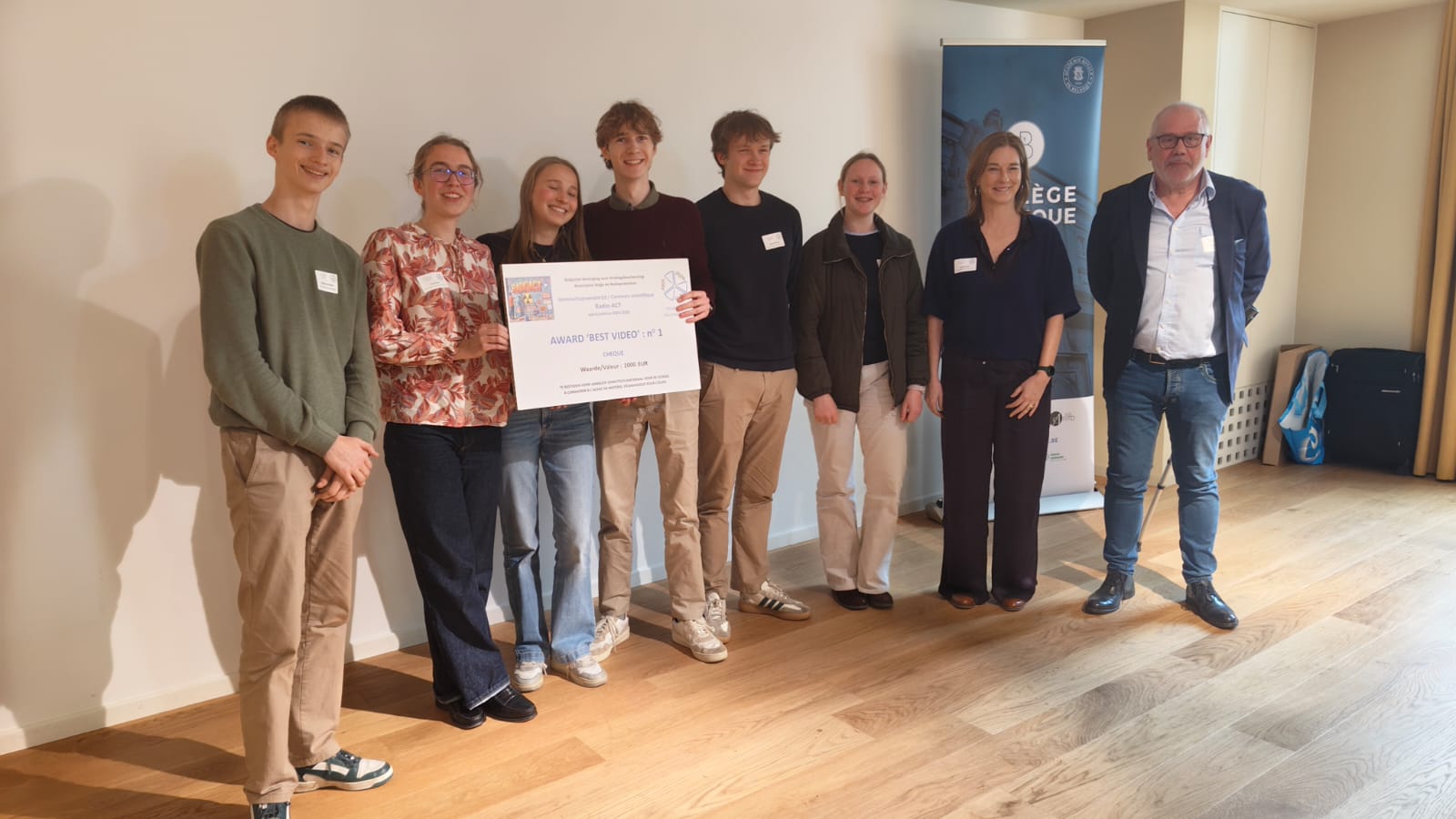
Laureates of the Best Video award of the BVS-ABR Science contest RadioACT 2025-2026:
Sint-Jan Bergmanscollege Brussels with their coach Simon Coenen.