RadioACT! Science contest 2026

The Belgian Society for Radiation Protection (BVS-ABR) has been committed to promoting knowledge and awareness in this field for more than 60 years. After a successful science competition in 2023-2024, we organised another challenging competition for 5th and 6th secondary school pupils in 2025-2026.
In an age when information floods us through numerous channels, it is increasingly difficult to form an informed opinion on complex topics such as nuclear science and technology. Social media, the internet and the rise of generative AI make us both more vulnerable to misinformation and disinformation.
- Misinformation arises from unintentional mistakes in sharing information.
- Disinformation, on the other hand, is a deliberate attempt to distort facts and manipulate our view of reality.
Ionising radiation and radioactivity have fascinated society for more than a century. From films and comics to art and music, popular media have shaped this theme in creative ways. But while these expressions are often entertaining, they have also contributed to misconceptions and an image which is inconsistent with scientific reality.
With this competition, we invited young people to separate fact from fiction, discover the science behind ionising radiation and think critically about what they hear, see and read.
Teams were invited to select an item that can be labelled ‘fake news’ related to the use of ionising radiation and/or radiation protection, and make an educational film of their analysis.
View the full description of the science contest.
Results and prizes
Sint-Jan Berchmanscollege from Brussels has won the RadioACT! competition 2025-2026. The winners chose to debunk the myth ‘The Fukushima nuclear disaster left large parts of Japan uninhabitable’.
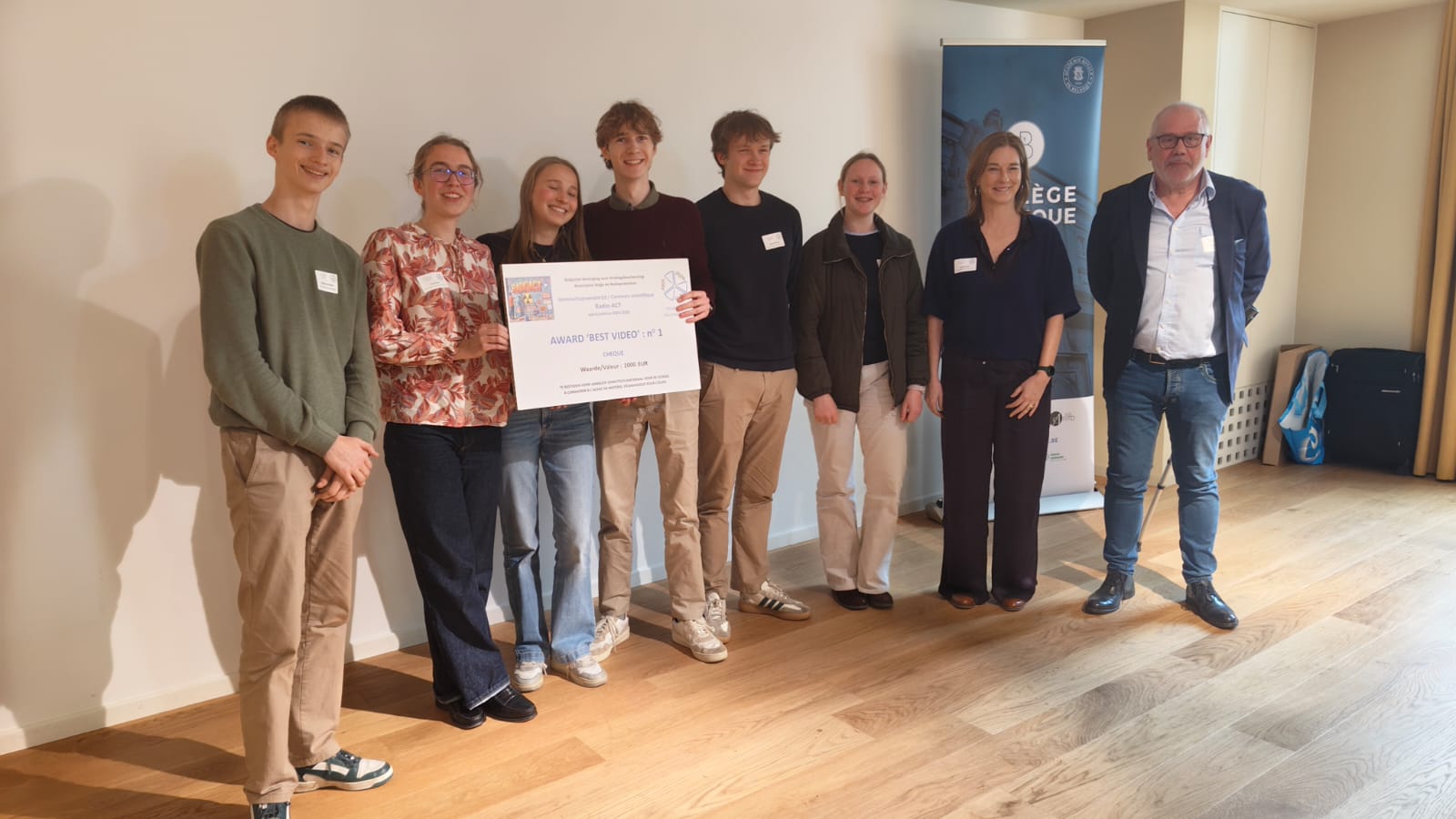
Laureates of the Best Video award of the BVS-ABR Science contest RadioACT 2025-2026:
Sint-Jan Bergmanscollege Brussels with their coach Simon Coenen.
Tom Clarijs, chairman of the BVS-ABR: “Scientific literacy, a critical reflection towards the use of social media and digital skills are now more than ever needed in our society. With this competition, we wanted to challenge youngsters and introduce them in the wonderful world of ionizing radiation. We hope that with this initiative we have been able to inspire young people into STEM and raise awareness of our field.”
On March 20, 2026, all video’s were showcased during a live event, and selected number of teams present their video in front of a jury of 9 experts. The public event is organised by BVS-ABR in Brussels (Académie Royale de Belgique, Hertogstraat 1, Brussels). During the subsequent award ceremony, the three winning teams receive their prizes.
The podium was ranked as followed:
1st place: Sint-Jan Berchmanscollege (Brussel) – The Fukushima nuclear disaster left large parts of Japan uninhabitable
2nd place: I. P. E. S. (Tubize) – Space may make astronauts infertile, scientists fear
3rd place: Sint-Maarteninstituut (Aalst) – De kerncentrale van Doel is schadelijk voor de gezondheid van buurtbewoners
A dedicated ‘Best Social Media Coverage’ award was also given to the team who managed to effectively communicate their ‘making of’ during the contest via social media.
The REACT Team from IPES Tubize won this award.
Thanks to our sponsors, all participants present at the final event received a goodiebag and tickets to Tabloo, the visitor centre of the National institution for radioactive waste and enriched fissile materials (NIRAS-ONDRAF) in Dessel. At Tabloo, they can learn more about radioactivity, radioactive waste and the search for new nuclear applications. In addition, the first three teams received a cash prize that will enable them to purchase educational materials for the classroom.
View below all created video’s from the teams:
Sint-Jan Berchmanscollege Brussel
De KernKritische Kanjers
The Fukushima nuclear disaster left large parts of Japan uninhabitable.
IPES Tubize
Radiation Exposure Analysis & Countermeasure Team (REACT)
Space may make astronauts infertile, scientists fear
Sint-Maarteninstituut Aalst
SMI Science Team
De kerncentrale van Doel is schadelijk voor de gezondheid van buurtbewoners.
Lycée Provincial des Sciences et des Technologies (LPST) de Soignies
Les darons du radon
Le radon, ce n’est un problème que dans les centrales nucléaires ?
Sint-Paulusinstituut Herzele
Een patiënt die net uit een nucleaire behandeling komt is een gevaar voor zijn omgeving.
Sint-Paulusinstituut Herzele
De Mosselmannen
Een portie mosselen pantsert je tegen ioniserende straling
ZOOM Freinet Kortrijk
Kernfusie gaat geen kernafval opleveren
Een kernreactor kan ontploffen net zoals een atoombom
De grote schouwen van kerncentrales stoten veel radioactiviteit uit
Sint-franciscus Evergem
Van ioniserende straling krijg je superkrachten!
Sint-franciscus Evergem
Straling als liefdeselixer
Sint-franciscus Evergem
The Ballers
Een bestraalde voetbal beweegt anders dan een gewone voetbal
Sint-franciscus Evergem
Het koelwater dat een nucleaire centrale aanmaakt is radioactief besmet
Sint-franciscus Evergem
Wie een CT-scan krijgt, loopt net zoveel risico als iemand bij een kernramp.
De Kernclub
Een kerncentrale kan ontploffen als een kernbom.
Stedelijk Lyceum Explora Antwerpen
RadioExplo
Straling zorgt direct voor verandering van je DNA, zoals te zien in spiderman en X-men.
Liquidators
Stralingsziekte is besmettelijk
This contest was supported by the following sponsors: